
Anglican Church
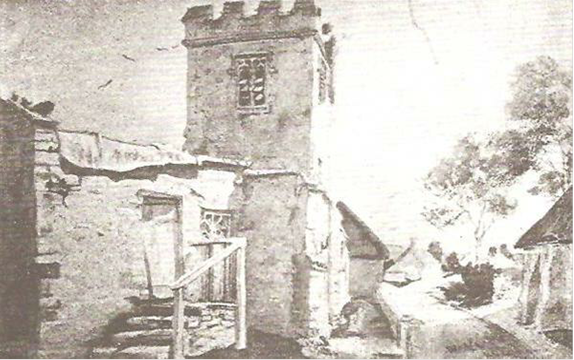
The old Norman Church, which stood on the north side of the main street, near the village stores, described as “very ancient, the smallest I ever saw” in 1791 by John O’Keefe, had originally one aisle, a low square tower, under which was the gallery, reached from the churchyard by an outside flight of stone steps and a small porch on the south side. In 1842 an extension was made, bringing the outside wall level with the porch and thus giving the Church a curiously lop-sided appearance.
In the gallery sat the choir with its flutes, violins, ‘cello and double bass. Much of the music was written by local musicians, and many in the village remember hearing of the parts played by their grandparents.
By 1869 the old Church had become dilapidated and inadequate for the needs of the inhabitants of West Lulworth. It was very close to cottages on either side, and the Rev. William Gildea, curate of Winfrith and later a Canon (non resident) of Salisbury Cathedral, whose living it was, of an annual value of about £130, arranged for the building of the new Church and Vicarage on a far more convenient site.
The new Church of the Holy Trinity was built from the designs of Mr. John Hicks of Dorchester, but owing to his death, was carried out by Mr. R. G. Crickmay of Weymouth, the pulpit, font, prayer desk and other internal fittings being from his designs. Messrs. Wellspring & Son, of Dorchester, were the builders. The Dorset County Chronicle of Thursday, 12th May, 1870 states: “The style is Early Geometrical Gothic, and it is built of Purbeck stone, the carved, moulded and highly finished portions of the stonework generally are of Bath freestone. The material of the old Parish Church was used as much as possible. The letters on the moulding over the east window of the transept (behind the organ) stood over a sixteenth-century window in the north wall of the old Church, and read ‘Robertus Lulleworth'” presumably the name of an ancient Lord of the Manor, after whom the village is named. “The rear arch springs from demi-angels bearing shields. In the chancel is an oak bench with carved framing and panels of the seventeenth century, which has been restored.” (A photograph of a sketch of the old Church is in the vestry.)
The foundation stone was laid by Lady Selina Bond, wife of Nathaniel Bond. Esq., of Holme Priory, the fifth daughter of the Second Earl of Eldon. “The stone itself was found buried a foot or two underground in the old churchyard. It now supports four arches, and underneath it was placed a glass bottle containing a newspaper and one or two coins of the year”. The brass plate can be seen behind the base of the lectern, and the inscription reads “This stone was laid by Lady Selina Bond, June 1st 1869, William Gildea, Vicar, William Randall, Thomas Randall, Jun.. Churchwardens”.
Catholic Chapel
St Mary’s Catholic Chapel was built.
The building ceased being used as a chapel. It is now let as a holiday cottage.
West Lulworth Congregational Church

- The Congregational Church opened in June 1869. It was an iron structure designed to seat 120. The total cost, including boundary walls etc., was about £250, and this was all raised on the day of opening.
- It was located on Main Road close to its junction with Church Road.

- Revd. Daniel Arthur Brown (1839-1914) was Minister in 1871
- Revd. Walter Ebbs was Minister in 1881 – he was lodging with Mary Erlebach, daughter of the late Adolphus Erlebach.
- Revd. D. Davies was Minister from 1887
- Revd. William Henry PICKEN (1847-1919) was Minister from 1911 to 1915
- In 1972 Congregational Church in England and Wales united with the Presbyterian Church of England to become became the United Reformed Church.
- The West Lulworth United Reformed Church closed in September 1995.
Page last updated: 10 May 2021